I have a cup of coffee near me now. Instant coffee and heated mineral water, a little milk, and I currently don’t add sugar, or add a little sweetener. I probably drink way too much coffee. When I brew coffee, I can easily drink a pot or more a day.
I do like other drinks, like Soda (Pop), fruit juices, alcoholic beverages, tea at times. Milk I only drink if I can get a gallon jug of it, otherwise I use it for cereal or for cooking. But since I have been diagnosed with type 2 diabetes, I limit consuming the other drinks.
Coffee is relatively affordable, healthy, and a comfort to drink. It’s possible that I self medicate and stimulate with coffee due to my autism and possible ADHD, but it probably does contribute to whatever sleep and anxiety problems I have.
My parents and grandparents were coffee drinkers, and I’m currently in a country with several cafes. I tend to make my own brews though to save money. I don’t mind Espresso, but my go to coffee is brewed American style. I feel like I get my money’s worth, even though it’s just extra water.
Coffee has been repeatedly proven to have several antioxidants and can offer resistance against several diseases and increase lifespan. And perhaps the coffee grounds can be used as a bio-char to add to strengthen concrete. So there’s probably a good reason why I drink so much coffee.
I went to ShowTime Pizza Place as a kid, likely after getting on my parents’ case begging to go. I remember being told no more than once, they can’t afford it. Understandable now, I didn’t understand at 8 years old. 50$ was a bigger chunk of change then.
ShowTime Pizza was a family friendly Pizzeria with a gimmick. It had a video game arcade with many of the most popular cabinet video games at the time- Pac-Man, Space Invaders, Donkey Kong, Joust, Defender, Burger Time, Sinistar and so on. Maybe some more obscure games that I don’t remember playing.
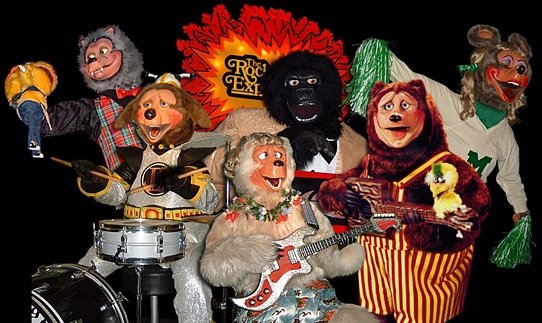
It also had a dining hall with a stage featuring singing and talking Animatronic Animal Characters, like Billy Bob Brockali, Looney Bird, Rolfe DeWolfe, and various other animal characters. These animatronic characters, along with the Chuck E Cheese Animatronics, were the inspiration for the antagonistic robots in Five Nights at Freddies “horror” movies and video games.
No, I never thought the animatronics were creepy. I thought of the furry characters as robots, which I continue to be fascinated by.
Anyways, my parents gave in, and I was able to go to ShowBiz Pizza Place for my 9th birthday. I remember the Pepperoni pizza and pitchers of Pepsi were tasty enough for a grade school kid. I remember being proud that I could eat 4 slices of pizza then.
I loved the video games, of course, and tried and failed to play the Legendary laser disk game Dragon’s Lair. I loved the Don Bluth animation, and that game ate up many of the tokens my parents gave me. I couldnt go far with that game though.
But what I remember the most about that pizza party at ShowBiz Pizza, was during the birthday meal, “The Rock-afire Explosion” band “talked and sang” to me directly to wish me a happy birthday. And I remember being touched by the nice gesture and being near tears that my parents cared enough about me to arrange the birthday shout-out with the Pizzeria staff.
So, yes, I enjoyed my time at ShowBiz Pizza, and I understand that it later merged With Chuck E. Cheese Pizza. One of those nostalgic fond memories, and it also contributed to my interests in robots, video games, comedy, and good food.
Unfortunately, my father died at 48, when I was 11. I so far outlived my father by 4 years, although I have many of the same vices he had that likely contributed to his early death by cancer. Smoking, drinking, probably not having the healthiest diet, although I made changes here and there. I’m eating oatmeal and flax seeds more often!
As for my mother, she was working as a property manager at a senior residential apartment until her own death of cancer. It was work, talking to the senior residents at the property, talking to family and friends, watching TV shows, cooking and baking her favorite recipes, listening to her favorite song playlists on the internet, smoking cigarettes and drinking coffee. The bright spot of her later years was family.
My mother remarried twice after my dad died, and her second marriage was ending around that time. It was amicable; she and her husband at that time were working different shifts, and weren’t spending much time with each other. And they did have different backgrounds, and probably didn’t have much in common otherwise.
The second oldest brother got married, and had 2 sons, and my mother was thrilled to have babies in her life again. She would spend time with my nephews, and of course baby sat at times. Being around little kids was a joy, and she would beam in many of the family photos taken during that time.
I’m trying to value what time I have left on this rock, not sure how much time I have left. But I have changed since my mother died. ~H
If you had the power to change one law, what would it be and why?
Ok, this is a thinker, and I had to research this some. I’m not a lawyer or work in law, so I hope that this makes sense.
I would change the concept of Legal or Juridical Personhood. It is a legal concept that’s the foundation of a number of laws in different countries, including the 14th Amendment in the US. By law, corporations, non government organizations, colleges, hospitals, churches, and really any non human entity like rivers can be granted Personhood if it has certain qualities like paying taxes and owning property. It’s a concept that seems to exist in business, government, and the judiciary.
It’s by law a fictional type of person. But this concept has powers that real persons do not, like surviving the deaths of owners and corporate members, and since many of these corporations ( not all) focus on profit and property, they often have more resources than real working people do. So they do have more power and resources than the ordinary person does.
They can hire lobbyists to influence government, invest more in political ads on different media, donate to candidates in their favor , have the resources to hire top lawyers, own much more property than the average person, have better access to bank loans and political deals, and sometimes be a monopoly in a certain business.
It just seems unfair to have the needs of fictional abstract “persons” to often take priority over real persons. So I would change that part of the law. Corporations are organizations with certain mechanisms that help with a goal, like making profit, or accomplishing a mission like healthcare. They are the legal equivalent of a bot. ~H
I’m not a home owner and never been a homeowner, and I prefer to rent. There’s advantages to renting. But if I could afford my dream home, it would be a modular home. Those interest me, what I know of them. The capacity to add on more square footage to a home, maybe one bedroom to start, and adding 2 or more bedrooms over time. The beds are comfortable memory foam.
I would like the home to be energy independent and efficient, so I would add solar panels, solar heating, and battery storage. Also heat pumps depending on what region of the world I would live.
I would like to have the property on at least 2 acres of land, with a garden to grow plants, vegetables, and maybe even egg laying chickens.
To prepare for any potential emergencies, I would like to have an emergency shelter buried deep underground, with water filters and a storage of non perishable food that can be stored for several weeks, maybe up to a year.
I would like a spacious living room with a decent entertainment center and comfortable seating, although I don’t need the state of the art with that. Just a game console or 2, and the ability to stream movies. But I prefer to have a fully equipped kitchen with a decent refrigerator and freezer. I or my potential spouse will try to cook more meals at home.
It would be nice to live in a pleasant suburb near a large city, like Chicago, Las Vegas, or Boston. Maybe possibly in another country, since I’ve been traveling.
I would like to have WIFI throughout the home, of course.
A balcony and/or patio, with the ability to grill out if I wanted to. A fenced in backyard, and in a decent neighborhood. And this dream home probably already costs at least a million dollars in the US. It’s good to dream though.
Survivors of fascism have endured profound and often harrowing experiences under regimes characterized by authoritarian control, suppression of dissent, and widespread human rights abuses. Their stories reveal the devastating impact of fascist rule on individuals and communities, as well as the resilience and courage required to endure and resist.
Many survivors recount living in constant fear due to pervasive surveillance, arbitrary arrests, and brutal punishments for any perceived opposition.
Families were frequently torn apart, with loved ones imprisoned, exiled, or worse.
Daily life under fascism often involved restrictions on freedom of speech, assembly, and press, making it dangerous to express any dissenting opinions.
Experiences also include witnessing or surviving targeted violence against marginalized groups, including ethnic minorities, political opponents, and other vulnerable populations.
Forced labor, internment in concentration camps, and systematic persecution were tragically common.
Despite these hardships, survivors’ testimonies often highlight acts of solidarity, resistance, and hope. Many participated in underground movements, helped hide those persecuted, or found ways to maintain their dignity and humanity in the face of oppression.
These firsthand accounts are invaluable for understanding the human cost of fascism and serve as powerful reminders of the importance of vigilance against tyranny and the defense of democratic values.
Organizations and memorial projects around the world work to preserve these stories, ensuring that the lessons of the past inform our present and future.
Name an attraction or town close to home that you still haven’t got around to visiting.
I’m actually a perpetual tourist now, so this is a complicated answer. I’m country hopping partly because the United States has gotten too expensive for someone on a limited income. But I was born and raised in Milwaukee.
There was a good number of attractions that Milwaukee has that I never visited. It was partly because I live on a lower income, and could only afford to visit places that actually interested me. But the War Museum near the Lake Michigan lakefront was a place I would be close to but never visited, and the Pabst Mansion was another. Both buildings contain a lot of history. I also don’t drive, so I couldn’t afford to stay longer in nearby towns like Kenosha and Racine.
I tend to be a home body, partly because I associate going outside for prolonged periods of time with spending money! Seriously, if I want to go somewhere else besides my local neighborhood, I more often than not have to spend money. It adds up.
Anyways, I’m currently in a Central European country with its own history and attractions. I’ll try to visit the Bunk Art museum attraction sometime during my stay here, but I already been here over 2 months, and I still can’t afford to visit yet!
I’m hoping to check out the unique architecture and exhibits in the largest city next month, even if it’s a one day tour. So many places to visit, but so little time and money.
I snack too much, and I have snacks right in front of me now. Some pretzel and cracker mix I had yesterday that’s good and I bought cuz it’s more affordable than Doritos.
Yes, I love Doritos, and I do buy them. I can’t afford to buy them as much as I would like though. And I have other snacks at times, like cakes, ice cream, chocolate, mixed nuts, crackers, potato chips, and so on. I’m not a fan of the diet type of snacks (apples with peanut butter, celery with low fat dressing). Popcorn is ok at times. Doritos all the way for me, even better with nachos and dips!
I wouldn’t be surprised if I have a Doritos addiction, cuz no other brand of tortilla chips are as satisfying as Doritos are. It’s a comfort food for me, one of many.
This is the choice I had as a senior in high school back in 1991, about to graduate and make my own way in the world. My dad died when I was 11, so my mother worked a lot trying to support my 2 brothers and I. Since it was a struggle to support the family on a single income, my mother gave me the choice of either joining the military, where I could learn a job skill or several through apprenticeships, or stay with my mom and brothers, and go to college for a formal education while she paid for my tuition and books. Maybe I could work a job to help with the fees.
I had my reasons to join the military after high school graduation, one of them being that I didn’t want to burden my mother with the extra expenses of school. Learning a job skill, seeing the world, maybe toughening up some since I was a gawky nerd while in public school. I was very green, naive, and sheltered. But I would qualify for the Montgomery GI Bill, if I joined the military. I could go to college later, if I chose so. (I did, 10 years later.)
Was the Air Force a good experience? Yes, and no. I met some good people, did go to different parts of the US and some other countries, learned how to be a professional military cook and basic service specialist, learned some military culture and lingo, and didn’t screw up so much that I was able to get an honorable discharge after 2 terms of service. It was sometimes stressful, sometimes loud enough that I developed tinnitus from the noise of war machinery, and I had to cope with the politics (workplace and geopolitical). I also developed habits like smoking and the occasional binge drinking, and I became more jaded and vigilant. I wasn’t burned out yet, but I lost a spark I had at 18.
I started to go college when I was 27, sometimes older than the other students. While I did study and did well enough in some courses, there was some other courses I couldn’t keep up with, or in some cases was completely lost. Astrophysics 2 showed that I’m terrible in advanced math, and intermediate algebra seems to be my limit.
I got so burnt out from reading college textbooks that I don’t have the attention span for reading books anymore. I’ll read online summaries or specific quotes or facts about a topic instead. I ended up dropping out of getting a bachelors degree partly cuz my grades weren’t good enough (with autistic spikes), and I couldn’t afford to finish college.
So why would I chose college over the military after highschool? Money, time, and energy. I was more energetic, healthy, and idealistic at 17-18 years old than I was at 27-28, college was cheaper (yet still costly), and I would spend more time with my family. I would probably have a better formal education than I do now, maybe working as an engineer or professional writer. I also probably wouldn’t have developed the wanderlust I have for travel if I just stayed in my hometown, instead of the 7 countries I was able to visit while in the military.
I’m not sure if it was a better choice, but maybe I would have chosen a different fork in the road knowing what I know now.
In the United States, value can be represented in various forms, and assets are items or resources owned by individuals or entities that hold economic value. Here’s an overview:
### Forms of Value in the U.S. 1. **Currency** – Physical cash (coins and banknotes) – Digital currency (balances in bank accounts)
7. **Other Forms** – Collectibles (art, antiques, rare coins) – Business equity or ownership shares
### What Can Be Considered Assets? Assets encompass anything of value that can be owned or controlled to produce positive economic value. Common categories include:


 HETTY
HETTY 
You must be logged in to post a comment.